|
Coming Soon Contact Join Our Mailing List Complete Catalogue of CDK Music
|
|
Help
Iraqi Children! Order an exclusive autographed copy
|
Maxim Berezovsky
|
||||||||
|
Frederic Chopin, Alexander Scriabin
Igor Zukov has played at all the major venues around the world drawing acclaim and recognition. His interpretation of Chopin's and Scriabin's preludes is notable for freshness and delicacy. Zhukov's performance embraces the best features of great Russian piano tradition.
|
Pyotr Tchaikovsky
Being
already an accomplished pianist, Richter never passed the exam to enter the
Moscow
|
||||||||
|
Pyotr
Tchaikovsky
Rostropovich - Cello This album features top Russian artists: Mstislav Rostropovich, the Borodin String Quartet, Gennady Rozhdestvensky and the Leningrad Philharmonic Symphony Orchestra performing two of the most precious compositions of Russian classical repertoire: Variations on a Rococo Theme and Souvenir de Florence by Pyotr Tchaikovsky. |
J. S.
Bach Igor
Oistrakh - Violin
|
||||||||
|
Armenian Sacred Music
Armenian sacred music is the most ancient among Christian musical cultures. It is distinctive not only in its melodies, but also in structure, which differs from the Western forms.
|
The USSR
Symphony Orchestra The role of Mikhail Glinka (1804-57) in Russian music is comparable to the role of Shakespeare in English literature. Glinka established the Russian national music school. Tchaikovsky wrote that "all Russian music was contained in Glinka's "Kamarinskaya" like a majestic oak in a tiny acorn".
|
||||||||
|
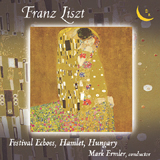
Franz Liszt
Symphonic Poems
Liszt's commitment 'to translate literature into music' resulted in the creation of new aesthetics known as program symphonism. Many of Liszt's disciples turned his idea into an absurdity of primitive musical illustration of literary origins. They did not understand that music and literature might just have the same spiritual source, which was called by Liszt 'a program' and the unfolding of spiritual content as 'a plot'. The best music inspired by literary origins has never been an illustration /accompaniment/ of the literary work. The spiritual origin was inspirational to both forms of art.
|
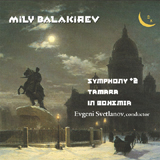
Mily Balakirev
The Mighty Five collected and used in their compositions much more foreign folklore than any other national music school. A desire to become a voice of their own people and to talk to the world on their behalf encouraged many composers to learn different musical cultures.
|
||||||||
|
The history of
performing art knows many artists who enjoy great popularity among their
|
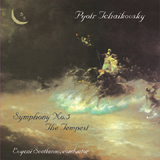
The
USSR Symphony Orchestra Pyotr Tchaikovsky's symphonic fantasy on William Shakespeare's "The Tempest" begins with a picture of the calm sea. But Ariel, by order of Prospero, raises the tempest, trying to sink the ship. The violence of the element is skillfully reflected in the music, where the breathing of the sea seems to be heard.
|
||||||||
|
The
USSR Bolshoi Theatre Chamber Music Ensemble Haydn was the author of over a hundred symphonies. Such a prolific output is a key to the understanding of his creative work as a life-time development of the same symphonic model. This album introduces conductor Mark Ermler's recordings of the first symphonies by Haydn made in 1987 and 1988 with the USSR Bolshoi Theatre Chamber Music Ensemble.
|
The
USSR Ministry of Culture Symphony Orchestra This album represents the most popular music of the Strauss
family. Johann Strauss I (Senior) begged his
|
||||||||
|
Pyotr Tchaikovsky
Liturgy of St. John Chrysostom is the earliest sacred composition by Tchaikovsky. The performance, the acoustics of the Smolensk Cathedral and the quality of the recording are outstanding.
|
Alexander
Scriabin The
USSR Symphony Orchestra Scriabin was a composer-philosopher who "like Bach and Beethoven erected churches and temples on the heights". His Symphony #1 opened the new era of Russian symphonism. It reveals to us the new phenomenon in the Russian music known today as Scriabin.
|
||||||||
|
Russian Sacred Music The Glinka Choir Vladislav Chernushenko, director of the Glinka Choir, succeeded in convincing the atheist-minded Soviet officials of the necessity to include forgotten masterpieces of Russian church music in their repertoire. Their performance restored the entirety of Russian musical tradition and made its roots much more obvious.
|
What warmth and passion in Grieg's melodic phrases, what teeming vitality in his harmony, what originality and beauty in the turn of his piquant and ingenious modulations and rhythms... add to all this that rarest of qualities, a perfect simplicity. This album embraces piano miniatures written in different periods of Grieg's life performed by one of the greatest Russian pianists of our time - Mikhail Pletnev.
|
||||||||
|
The
USSR Symphony Orchestra Kalinnikov was poor and sick with tuberculosis. During his life, his name was known well only among members of his family. You may see, that nothing has changed in the music industry in a hundred years - the dead composers are much more welcome than alive!
|
Anton Bruckner The
USSR TV and Radio Large Despite the fact, that his symphonies underwent multiple alterations, Bruckner always kept the original scores for "later times." The recording embodied on this cd is not the usual one, because it is the original version of Bruckner's symphony.
|
||||||||
|
Ludwig van Beethoven The
USSR TV and Radio Large Symphony Orchestra Prometheus has often been described as the Christ character in Greek mythology since they saw him as the redeemer and saviour of humanity. Beethoven considered the Prometheus self-sacrifice as the highest form of heroic action. |
Alexander Borodin The
USSR Symphony Orchestra Despite his versatility and exceptional achievements in different scientific fields, Borodin was a modest man and acknowledged himself as a dilettante in music; but it was his "hobby" that has made his name for posterity. Borodin's symphonies are among the earliest Russian compositions in this genre. They are not only of epic scale but also of epic character, which determines all elements of musical language and distinguishes Borodin's symphonies from symphonies of other Russian composers.
|
||||||||
|
Pyotr
Tchaikovsky
With Russian classics as the focus of his attention, The USSR People's Artist, Lenin prize winning conductor Evgeni Svetlanov constantly tackled works of different styles. His name is well known all over the world.
|
Haydn's setting of "The Seven Last Words of Christ" for string quartet perfectly expresses the dramatic moment of crucifixion and brings an intimacy which lets every listener perceive the last minutes of Our Savior's earthly life privately.
|
||||||||
|
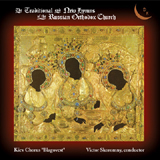
The Traditional and New Hymns Choir
Blagovest This album introduces rare, first published hymns of Kievo-Pecherskaya Lavra. The origin of these hymns is different, but all of them have been in use at this monastery during a long period of time. The roots of this music stretch back to the 11th century.
|
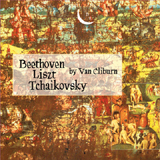
Van
Cliburn - Piano Van Cliburn's performances were recorded live during the most memorable days of the pianist's career - his victory at the Tchaikovsky Competition in Moscow, in 1958. It is amazing that the quality of the recording is comparable with studios - the Russian audience does not clap during pauses and it does not chew popcorn! |
||||||||
|
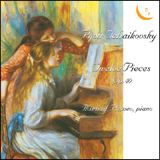
Pyotr Tchaikovsky
Pyotr Tchaikovsky's miniatures, intimate and sincere, with rich melodies and simple to perform, speak to everyone. Pianist Mikhail Pletnev spoke of performing the cycle, "When I play this music I seem to become immersed in the atmosphere in which the composer lived, as if I am reading his diary or memoirs. And a new facet of Tchaikovsky's perception of life opens up to me, reflected in his music." |